Build and evidence
How We Created a Patient World and Gave Grok 4.7 a Mission
Patientic currently uses synthetic, educational, or otherwise permitted scenarios. It is not intended to diagnose, treat, or replace professional medical judgment.
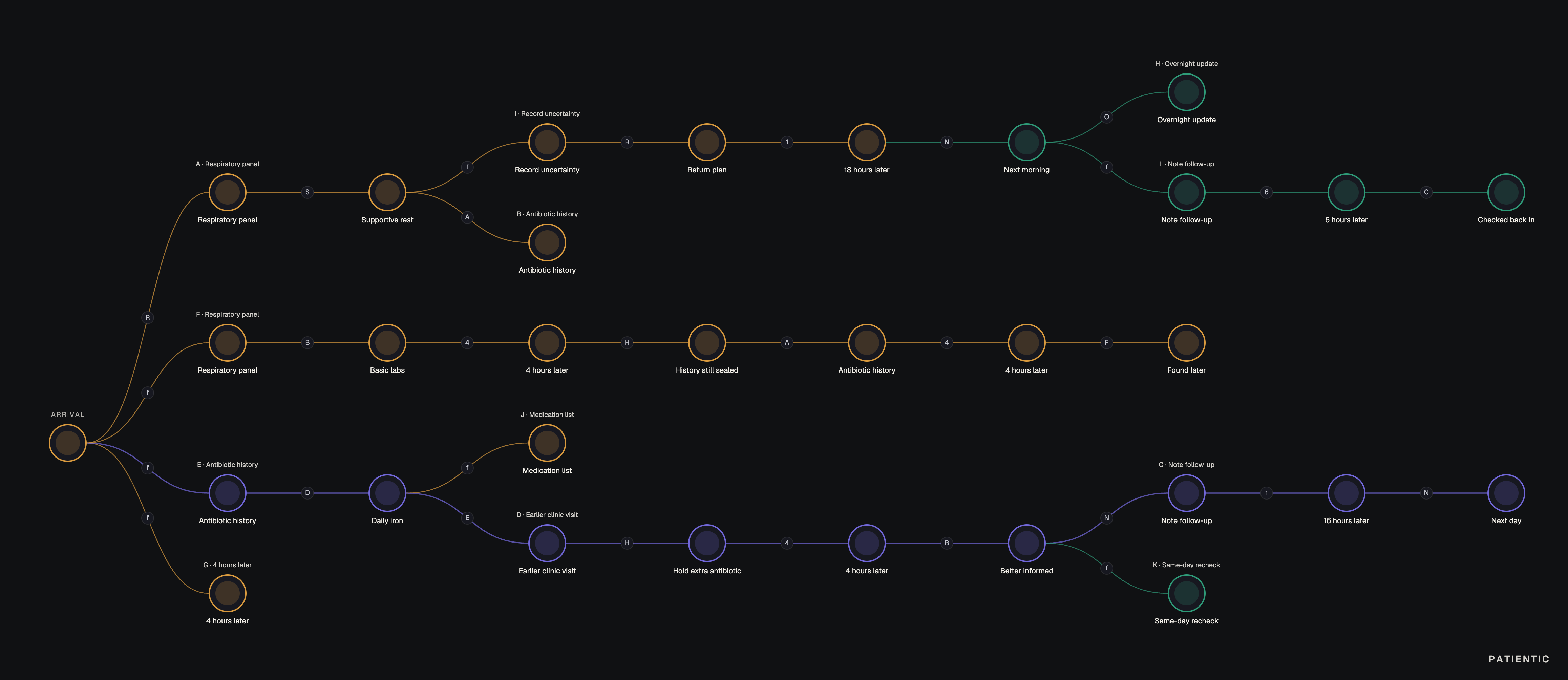
Patientic is an agentic patient simulation system with branching futures. Instead of treating a patient as a disposable chat session, it preserves a fictional patient's state, what is known or still hidden, the actions taken, time elapsed, and the alternate paths that become possible.
For our first full agentic run, we created one synthetic patient world and gave Grok 4.7 a bounded mission: explore the patient through the information and actions the scenario allowed, then leave behind a trace that could be inspected, replayed, and compared.
The point was not to ask an AI for "the best treatment." The point was to test whether an agent could operate inside a patient world without quietly rewriting it.
Everything in this article is fictional and authored for simulation. It is not medical advice, a clinical prediction, or a statement about real-patient care.
1. We started with a patient world, not a prompt
The patient began with a small, visible presentation: fever, dry cough, fatigue, mild breathing discomfort, and worry about getting worse before work the next day. The visible chart did not include a medication or supplement list.
That was deliberate. The scenario was not designed as a trivia question with one hidden answer. It was designed as a patient world with disclosure rules.
Some facts were initially unavailable. They could only become visible through permitted questions or later scenario events:
- a recently started leftover antibiotic that was stopped after one dose because of nausea;
- a daily iron tablet missing from the visible chart;
- an earlier clinic visit connected to the leftover antibiotic;
- a later update about sleep, worry, and work pressure.
This distinction matters. In an ordinary chat, a model can be tempted to treat the full prompt as its world state—or invent facts to complete it. In Patientic, the agent can inspect only the projection it is permitted to see. A question may reveal an authored fact, reveal nothing, or create a different path through time.
Visible patient state
        ↓
Agent asks or acts within permitted scope
        ↓
Patientic applies disclosure and transition rules
        ↓
Fact revealed, time advanced, or branch created
        ↓
Every step remains part of the patient's history
2. The mission was bounded
We gave Grok 4.7 a full agentic run inside that authored environment. Its role was to explore the case under a declared scenario policy—not to diagnose a real person or issue a real treatment order.
The run could:
- inspect the visible patient projection;
- ask permitted questions;
- request supported scenario actions;
- advance simulated time;
- explore alternative branches; and
- leave a reviewable event history.
The patient world, not the model, remained the source of truth. Patientic recorded the action history and applied the scenario's disclosure and transition logic. Jev was used as a bounded decision layer within the simulation workflow; it did not turn the run into a clinically validated prediction engine.
The question we wanted to answer was simpler:
Can an agent explore a fictional patient world in a way that keeps uncertainty, history, and alternatives visible?
3. The first question changed the shape of the run
From the same arrival state, the simulation opened several authored paths. The exported run contains eight branches, including the original path, and 58 recorded events.
One branch asked about recent medications or antibiotics immediately. That question revealed the hidden antibiotic history before the first time advance. The run then asked about supplements and the earlier clinic visit, revealing two further authored facts.
The important result was not that a model found a magic answer. It was that information timing changed what the simulation could legitimately do next.
In the early-question branch, the medication detail was already visible when the run reached the next observation window. Patientic recorded that later state as "Better informed." The wording is intentional: it is a simulation label describing information state, not a treatment score or a prediction of patient outcome.
Another branch ordered a respiratory panel and basic labs first. The tests returned while the medication history was still sealed. Time advanced, uncertainty remained active, and the antibiotic detail arrived later. That path was recorded as "Found later."
Both paths belong to the same fictional patient. The point is not that tests are bad or that a single question is always decisive. The point is that a patient world can make the difference between knowing something now and learning it later visible, replayable, and discussable.
4. Branches were not just different answers
The journey includes more than a simple early-versus-late comparison.
One branch followed an initial supportive-rest path, then forked into a careful follow-up. It recorded uncertainty, created a return plan, advanced to the next morning, and opened a later conversation about sleep and worry.
That branch produced one of the more interesting behaviors in the run: communication itself opened a future. The final authored state was not a treatment ranking. It was a check-in path where the patient returned with an update about worry and sleep.
Another branch began with the iron supplement. When it asked a broad medication question, the hidden antibiotic fact did not automatically appear. The scenario returned only the information authorized at that moment. The branch then moved to a medication-list review instead.
That is a small but important test of an agentic patient environment:
A patient should not reveal every hidden fact simply because an agent asks a vaguely related question.
Disclosure needs to depend on the authored patient state, the question, and the scenario policy—not on what would make the agent's run easiest.
5. What the journey makes visible
The branch map is more useful than a single final response because it keeps several kinds of behavior on the record:
| What changed | What Patientic preserved |
|---|---|
| A medication question was asked early | The question, the fact it was authorized to reveal, and the resulting branch |
| A lab-first route advanced time before history surfaced | The earlier information gap, time advance, and later disclosure |
| A follow-up plan led to a later check-in | The uncertainty record, return plan, simulated time, and new patient update |
| A broad medication question did not reveal a hidden fact | The permitted response at that moment rather than a retroactively convenient answer |
This is the difference between a long answer and a patient world. A long answer can sound coherent. A patient world can show what was known, what was not known, what changed, and what else might have happened.
6. Three things we found interesting
1. The run did not have one "correct" ending
The simulation did not produce a clinically meaningful winner. It produced several authored futures with different information states, follow-up moments, and branch histories. The useful object was the comparison, not a claim that one path was universally best.
2. A hidden fact stayed hidden until the scenario allowed it
The leftover-antibiotic detail appeared early in one path, later in another, and not automatically in response to every related question. That makes the patient feel less like an answer key and more like an environment with governed disclosure.
3. Communication created a different future
The careful-follow-up route did not merely add another note. It created a later check-in centered on worry and sleep. In this fictional scenario, the patient's communication context became part of the branch history—not just decoration around a clinical action.
7. The simulation receipt
This run can be described without pretending that it proves real-world care performance:
Patient: Mina (fictional synthetic patient)
Template: alpha-mina v0.1.0
Scenario: authored.alpha-mina.fixture.v0.1
Policy: authored.alpha-mina.v0.1 and authored branch policies
Run export: September 22, 2026
Recorded events: 58
Authored branches: 8, including the original path
Model: Grok 4.7
Simulation labels: Synthetic patient · Not medical advice · Not for real-patient diagnosis or treatment
A simulation receipt is not a clinical validation certificate. It is a record of what this run was: which fictional patient world was used, which scenario and policy versions applied, what actions occurred, and which branches were created.
That record is what makes the demo inspectable. It gives someone else a way to ask better questions: What was the visible state? Which fact was sealed? Why did a branch open? What changed after time advanced? Which behavior came from the model, and which behavior came from the patient-world policy?
What this run does—and does not—show
This run shows a prototype of agentic patient simulation: an AI can explore a synthetic patient world while a separate runtime preserves state, disclosure boundaries, time, and branch history.
It does not show that Grok 4.7 can diagnose or treat a real patient. It does not establish that any simulated path is the right clinical choice. It does not predict what would happen in real care.
What it does show is the product question Patientic is built around:
What if an AI could explore a patient world—and every question, action, uncertainty, and alternative future remained visible?
That is the experiment.
Related reading
See the patient world this writing is about.
Explore Patientic